Why Green Design?
Global changes over the last century have contributed to a disconnect between humans and the environment. Rather than seeing ourselves as an intricate and essential part of life's cycle, we believe that we have power over Earth's ecosystems. As indicated by mounting scientific research from all corners of the globe, that approach is simply not sustainable, and our current way of living must be overhauled.
During the next century, as population doubles and resources available per person drop by one-half to three-fourths, humankind will have to drastically alter fundamental ways of thinking and operating in order to survive. The number one challenge that will face today's children as they enter adulthood will be how to reconcile the impact of their daily lives with the limitations of our global ecosystems.
Green design is one of the ways we can limit our impact on the world's systems. Justifications for green design are plentiful, but are summarized below as related to Environment, Health, and Children's Rights.
Environment
Human activity threatens ecosystem health. Businesses and other organizations have a responsibility to address some of these harms.
The 2005 Millenium Ecosystem Assessment Report (the first ever global assessment of Earth's ecosystems, spearheaded by the United Nations), paints a fairly grim tale about our ability to correct our course unless we act boldly and quickly. This landmark study, written by over 1,300 scientists from 95 nations, reveals that approximately 60% of the ecosystem services that support life on Earth are being used unsustainably. Scientists warn that the harmful consequences of this degradation could grow significantly worse in the next 50 years, seriously affecting human well being.
Ray Anderson, CEO of leading sustainable business Interface, notes, "The imperative of our times, and all time to come, is that the industrial system adapt to its utter dependence on the natural world. If the limits on nature's ability to supply humankind's demands for eco-services: air, water, energy, materials, food, and waste processing are not respected, we will kill ourselves. We cannot live without those services. Earth is finite in its ability to supply them. Present ways just cannot go on and on and on without dire consequences."
Health
Indoor Air Pollution
Indoor air pollution caused by standard exhibit construction materials threatens human health, with children most vulnerable of all.
Children learn best when they are in environments that fully support their health and growth. Staggering increases in childhood illness, like asthma, allergies, chemical and environmental sensitivities, respiratory disorders, cancers, and ADD, have all been traced to indoor air pollution as a source.
Indoor air pollution is linked, in turn, to standard exhibit construction materials: plexi-glass, laminates, fiberglass, plywood, paints, solvents, adhesives, carpeting, stains, finishes, wood, metal primers, wall coverings, sealants, particleboard, drywall compound, fabrics, and furniture finishes.
Indoor air is generally considered to be three times more toxic than outdoor air. Standard building materials emit low-level toxins years after initial construction. By some estimates, it can take up to ten years for some materials to finish off-gassing.
Children are considerably more vulnerable than adults to environmental exposure. The Children’s Environmental Health Network has written an overview of this complex subject, which includes what types of exposures affect children and. Their website also contains useful links and resources on the issue of children’s environmental health. Or, for a quick review of the key factors, look at our list of five factors that work against children when they confront any indoor environment, greatly increasing the risk of toxicity and disease. As exhibit designers and builders, we have to be even more careful about the choices we make on behalf of young audiences.Children's Rights
It is imperative that we consider our obligation to protect children's right to survival, to be protected from harm, and to have appropriate developmental opportunities. When we work sustainably, we model for children how to find that innate, subconscious connection with and love for the rest of life.
As German theologian Dietrich Bonhoeffer wrote, "The ultimate test of a moral society is the kind of world that it leaves to its children." The Convention on the Rights of the Child, a universally agreed upon set of non-negotiable standards and obligations developed by UNICEF, outlines basic human rights for children everywhere, including rights to survival, to develop to their fullest potential, and to be protected from harmful influences, abuse, and exploitation.
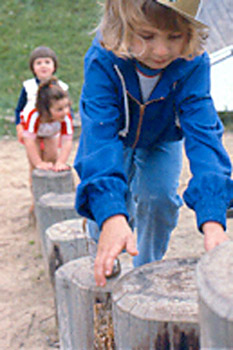
Children also need connections with Earth, especially direct experience with growing, living things, and the breadth of sensory variations that are exquisitely present in nature. In our increasingly human-made world, children are losing opportunities to explore nature unencumbered by watchful adults. Few children today are growing up with childhood memories that many of us cherish—exploring meadows, building forts in vacant lots, or climbing trees in neighborhood woods. Nature provides the best playground for open ended, timeless play that inspires wonder, awe, and the chance to marvel and imagine. Time outdoors also helps cultivate connection to the natural world that supports and sustains all of us.
By switching to sustainable practices and greater use of organic natural materials, we help preserve and foster Earth's ecosystems, which will nurture and support our children's future, and help protect their growing bodies from harmful chemicals. When we create exhibits and environments made with sustainable, natural materials, children are also afforded the opportunity to practice the kind of freedom they experience in the outdoors—to roam and explore a diversity of natural surfaces, textures, smells, and sounds in a safe environment. If we can't send today's children out to play with the same freedom, we can bring materials of the outdoors inside, cultivating connection. Children, like adults, are unlikely to work toward saving something they don't inherently love.