Exhibits Case Studies
Madison Children's Museum100 North Hamilton Street
Madison, WI 53703
http://www.madisonchildrensmuseum.org
Brenda Baker (contact)
bbaker@madisonchildrensmuseum.org
Exhibit Title: Possible-Opolis
Web Link to exhibit: http://madisonchildrensmuseum.org/exhibits/possible-opolis/
Project Budget: $148,000
Exhibit Square Footage: 2,400 ft
Cost per square foot: $73/sq. ft.
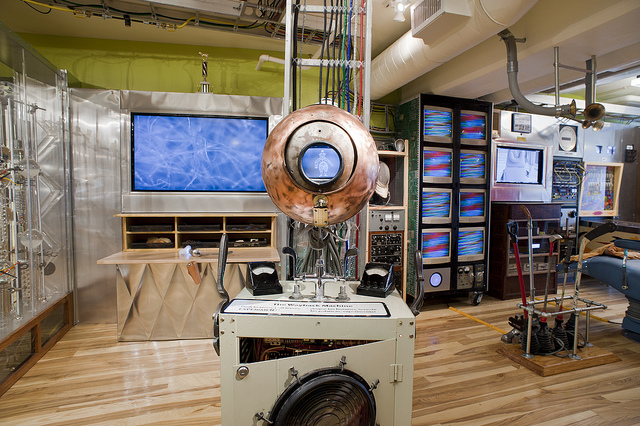
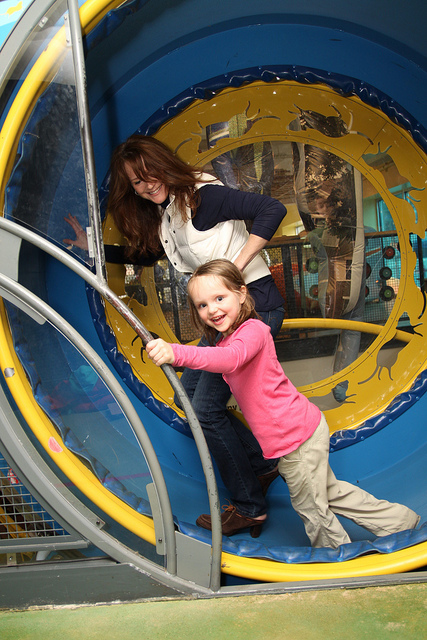
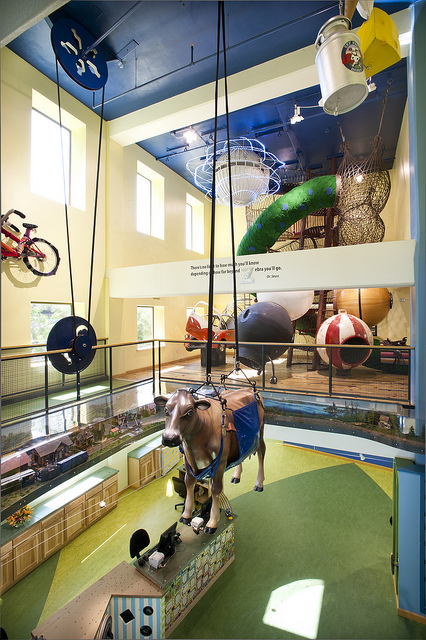
Possible-opolis™ is a whimsical, open-ended interactive environment for ages 5 and up that celebrates the wonders of invention and creativity while engaging children’s brains and hands in solving problems. Located on the second floor in the Bolz Gallery, this loosely knit “city” inspires kids to see the world as full of possibilities. Possible-opolis™, built at the intersection of art and science, uses more than 90 percent recycled, reclaimed, salvaged, and repurposed materials. Kids will enjoy the Wayback Machine, an interactive electronic playground; Hodgepodge Mahal, a two-story climber made from salvaged and repurposed materials; the Gerbil Wheeel, which harnesses kid power to demonstrate the amount of energy generated through physical activity; and the Cow Hoist, which employs pulleys along with block-and-tackle rigs and a harness to raise and lower MCM’s beloved cow, Gertrude, from Possible-opolis™ to the first-floor Community Concourse.
Distinguishing green features:
- Benches crafted by University of Wisconsin-Madison woodworking students and professors using local hardwoods, reclaimed materials, and low- or no-VOC adhesives and finishes.
- Hodgepodge-Mahal Climber parts and pieces came from many sources: an old three-wheeled car from a scrapyard, a buoy from Lake Michigan, shovel handles no longer needed from Fiskars, and remnant slide parts from a slide company
- The Pie in the Sky Diner counter is made from two repurposed exhibits from our old museum. This helped decrease costs, increase fun, and keep an old exhibit from the landfill.
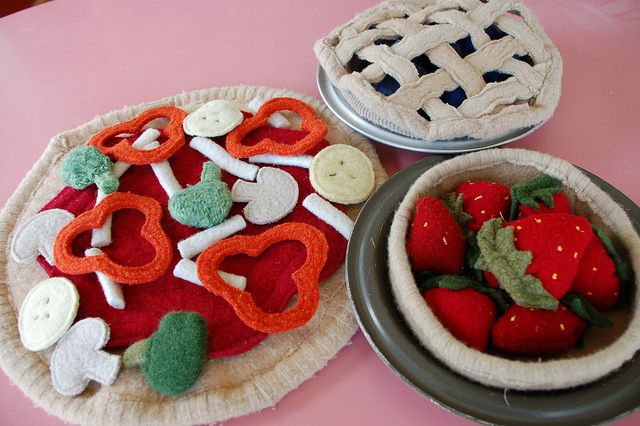
- Pizza and pie ingredients for the Pie in the Sky Diner are made from recycled sweaters
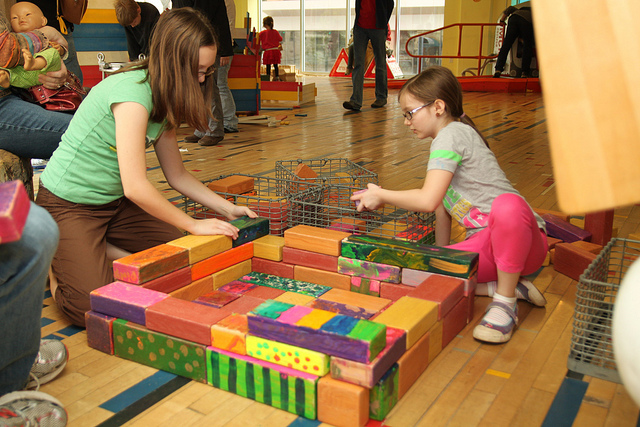
- In the ReFab Lab, old Madison street signs have been made into bricks and tables, old soda bottles are now building boards, and hollow-core doors are made into building blocks.
- The Punch Buggy is made from a 1950s three wheeled Trojan car, Weber grills, bookshelves, and other metal parts, while icicle targets were crafted using old billboard vinyl.
- Children are natural collectors. In the Whatnot Spot, the focus is on collections—appreciating things that are old, looking at the intrinsic beauty of objects in groups, and saving things rather than throwing them out. Incorporated into Possible-opolis™ is a beloved doll collection, a wooden animal collection from Ira Baldwin, and a handmade carousel and trains
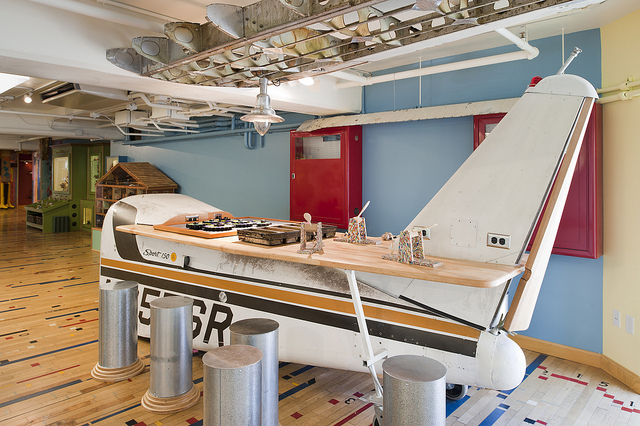
- A big part of sustainability education is emphasizing buying and using less in the first place. The Tinkerer’s Workshop, with its emphasis on tinkering and fixing things, helps teach children that learning to repair things can be lots of fun. The table was made from a reclaimed airplane, the countertop from an old exhibit, and the tool shelves from old fire hose boxes at the Wisconsin state Capitol!
- Most of the signs inside the museum are made of wood, aluminum, wheat board, Green Core board, or reclaimed materials. The wheat and Green Core board substrates contain no formaldehyde and are made from renewable resources like wheat or wood fiber. Exterior signs are mostly aluminum, with LED lighting used in our illuminated parking sign.
- The museum restored the building’s historic front window openings and installed high-efficiency low-e glass, bringing in a flood of natural daylight and reducing the museum’s reliance on artificial illumination.
Green products used:
- Non-toxic and zero VOC sealants and paints from Safecoat
- Salvaged counter tops obtained from Beloit College
- Old cisterns
- Reclaimed buoy from Lake Michigan (by way of a Milwaukee landfill)
- Satellite dishes
- Two repurposed 1958 BMW Isettas
- Reclaimed basketball court flooring, construction wood and cabinetry throughout
- Reclaimed musical instruments
- Cast-away technology components (A/V/digital/media/medical, etc.)
- Numerous repurposed exhibit components, furnishings and fixtures from the old museum
For more information regarding sustainable materials, visit the Build section of GE website
Piece of advice for others regarding project:
Our goal was to reach 100 percent recycled and salvaged materials. Know that goals are meant to be strived for, and even if you fall short of 100 percent, take pride in knowing that you tried for your goal to the best of your abilities. Due to health and safety codes, some structures for the Possible-opolis™ exhibit required the use of new or outsourced material that, while not fitting into our sustainability goals, were healthy, safe, and necessary to meet the deadlines and regulations regarding the project. Even so, our heavy reliance on used materials encouraged us to think outside the box in the repurposing of materials, reduced our overall consumption of new materials, and more easily work within budgetary restrictions.
Further Reading:
- Institutional Sustainability Mission: http://www.greenexhibits.org/plan/mcm_sustainability_mission.php
- List of Sustainable Criteria for Contractors: http://www.greenexhibits.org/plan/guidelines_for_contractors.php
- “Risk Taking Isn’t Risky”, (pdf) Brenda Baker (Madison Children’s Museum), Hand to Hand, volume 26, Winter 2011 http://www.greenexhibits.org/local/HandToHand.pdf
- “Learning from Leopold and Seuss”, (pdf) Brenda Baker (Madison Children’s Museum), Guest Editor, Hand to Hand, volume 20, Spring 2006 http://www.greenexhibits.org/connect/H2HSpr06.Brenda1.pdf
- Seeing Green, (pdf) Jeremy Schoolfield, Fun World, The International Association of Amusement Parks & Attractions, June 2005 http://www.greenexhibits.org/connect/Seeing_Green_Jun05FW.pdf
- "The Sustainable Museum: It's Not Easy Being Green," (pdf) Brenda Baker and John Robinson, Hand to Hand, volume 14, Winter 2000 http://www.greenexhibits.org/connect/the_sustainable_museum.pdf