Green Buildings Case Studies
Boston Children's Museum308 Congress Street
Boston, MA 02210
Phone: 617.426.6500
Fax: 617.426.1944
Contact: Kate Marciniec
Email: Marciniec@bostonchildrensmuseum.org
Website: www.bostonchildrensmuseum.org
Articles:
Green Buildings, Green Kids, (pdf) Neil Gordon (Boston Children’s Museum), Hand to Hand, volume 20, Spring 2006
http://greenexhibits.org/connect/H2HSpr06.Neil1.pdf
Hand to Hand interview: Follow the Trail: Our Green Trail, Onsite and Online Winter 2009/2010
http://www.childrensmuseums.org/docs/FinalH2HWin09SM.pdf
The Exhibitionist 9NAME magazine AAM – the exhibitionist Spring 2010) Splinters from Green Materials: Conversations about the Frictions of Green Exhibition Design – interviewed for article
http://www.hofl.org/images/HandsOnSplintersGreenNAME.pdf
http://www.bizjournals.com/boston/stories/2010/05/24/focus16.html?page=all
Architect: Cambridge Seven Associates, Inc.
Building Size: 175,000 Sq. Ft.
Project Budget: $47 million
Opening Date: April 2007
LEED Certification: GOLD
Project Description:
In a time of increased awareness and curiosity, educating our youngest generation to protect the environment has never been more important. As part of its renovation and expansion in 2007, Boston Children's Museum made a major commitment to green design and integrated design elements, which earned the Museum LEEDâ Gold certification from the U.S. Green Building Council. The Museum highlights this commitment in Our Green Trail, an interpretive exhibit that details the green building’s features.
Awards or honors:
- "Boston's Greenest," from AIA and the City of Boston in 2008
How Project is Sustainable:
This project is primarily sustained year after year through the building itself, particularly the more efficient use of resources related to the building’s green design. In addition, the goals and purpose of our green building are sustained online through the GreenTrail.org Website; the Our Green Trail exhibit inside the Museum; through educational programming about “green living” both at BCM and for families at home; through staff practices including a green “handbook”, a staff clothing swap, the elimination of disposable cups, etc. for meetings and more. The Museum also hosts a “recycle art” gallery show every Fall with new themes every year (past themes have included “Dirty Dozen”, “I See Trees” and “Heavy Metal”.)
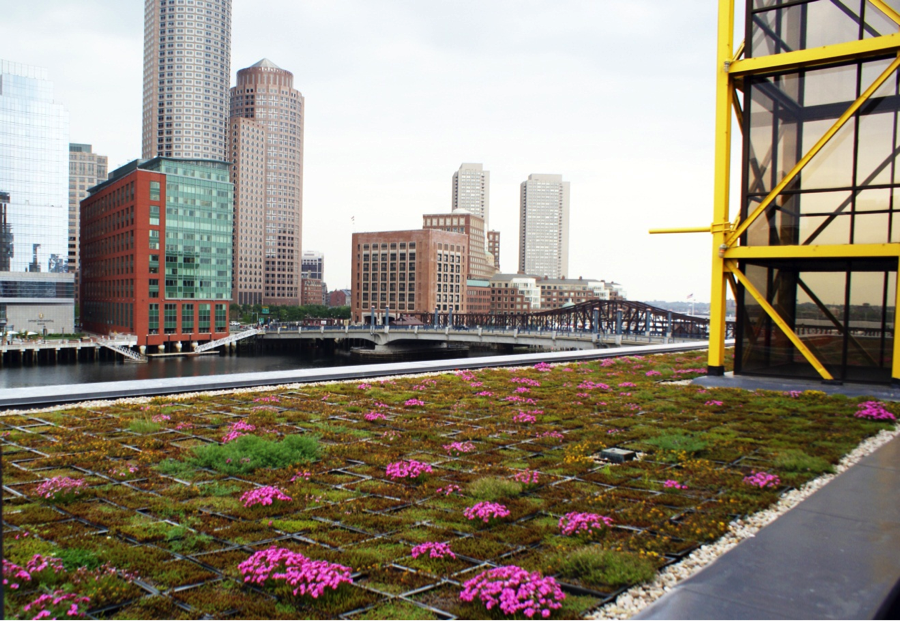
BCM’s Green Roof
Distinguishing green features:
- Storm Water Reclamation and Water-use Reduction
BCM harvests storm water from both the green roof and main roof for building services such as irrigation and dual flush toilets. The program helps to reduce water runoff into Fort Point Channel by 88% and potable water demand and use by the museum by 77%. - Real Time Heating and Cooling Controls
BCM has installed carbon dioxide measuring tools into the heating and cooling systems to meet real time occupancy needs. - Green Roof
BCM’s new addition is covered with a 6,400-square-foot green roof of plantings and organic materials. The roof helps to improve insulation, collect storm water, diminish height islands, and reduce air pollution. - Efficient Lighting and Features
BCM has replaced its ambient light fixtures with highly efficient fixtures that reduce energy consumption. - Materials
BCM chose recycled and rapidly renewable materials as well as materials with low volatile organic compounds (VOCs) during its expansion and renovation project. The museum also obtained 55% of the materials from locations within 500 miles of Boston. - Glass Addition
The 23,000-square-foot expansion includes full height windows that allow more natural light in, exterior walls that open for light and ventilation, new halide lighting to reduce energy, and perforated metal panels that reduce heat gain. - Green Cleaning/Housekeeping
The museum has developed a list of approved cleaning products and trained housekeeping staff on the proper way to store, use, and dispose of chemicals, paper products and other materials.
Green products used:
- Dual-Flush Flushometer Valve
- Efficient, Machine-Room-Less Elevator
- Electronic Dimming Ballasts
- Entryway Track-Off Systems
- Natural Rubber Content Floorcovering
- Pressure Water Cooler
Piece of advice for others regarding project:
Despite our best intentions, green/sustainable building materials are not always the best option. Weigh the pros/cons of buying local over buying ‘green’…sometimes environmental impact can best be mitigated by looking closer to home.
Sustainable design is not an 'add on'; it is simply a different way of approaching standard project tasks. To make that work, you need to develop clear and concise goals for your project related to green. With the goals in place and fully bought into by leadership and the board, your team can be creative and effective in how they think about everything from materials to systems.
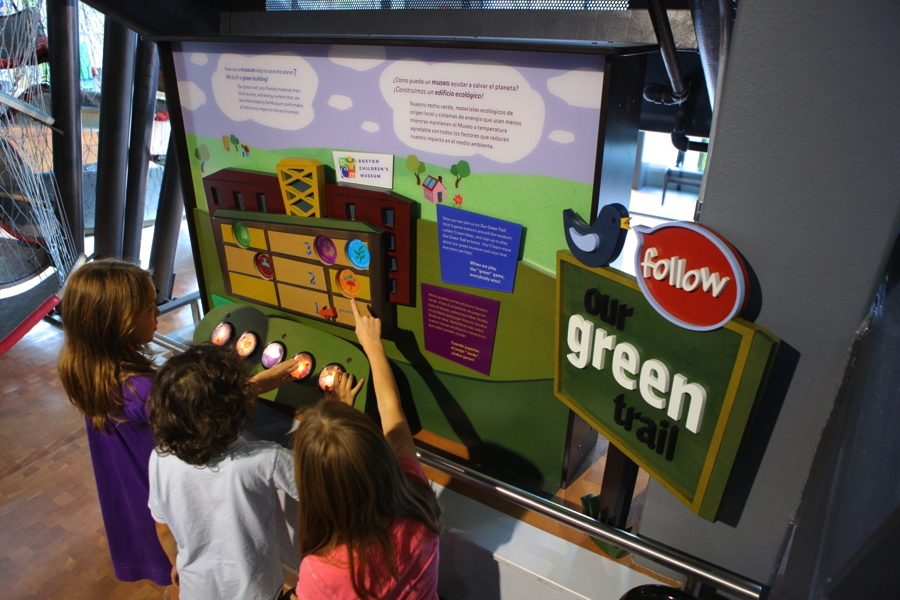
Our Green Trail
Visitor Feedback in response to green aspects of Project:
- “I never realized that we would enjoy learning new ways to make our life ‘green’”
- “Great lessons for my children to learn. It re-emphasized things we have taught them.”
- “I thought it was really good to teach kids to be green.”
- “The Game taught me that…”:
- “The Earth is important and we need to take care of it.”
- “It is all our responsibility to promote and live green.”
- “There are tons of little things we can all do around our house that are easy, but we might not have thought of originally.”
- “Small things can make a big difference.”
- “I never realized that it would be so easy to educate my child at such a young age about the importance of building a green community. “
New or Upcoming Green Projects:
BCM continues to implement Green activities and programming for our visitors throughout the year.